Measure the usable lid top
A nominal tin diameter includes the knurled or rolled edge. The label must stay on the flat lid top and clear that moving edge so opening the tin does not scrape the printed circle. Ask for the exact production tin, not a similar jar from a catalogue. A paper template placed on the lid quickly exposes an oversized cutline.
Check whether the lid is flat, domed or embossed. A large circle may bridge a shallow curve even when it fits the outside diameter on paper. If the client instead wants a sidewall band or tamper seal, specify that as a separate label with its own dimensions.
Keep the product name stronger than the decoration
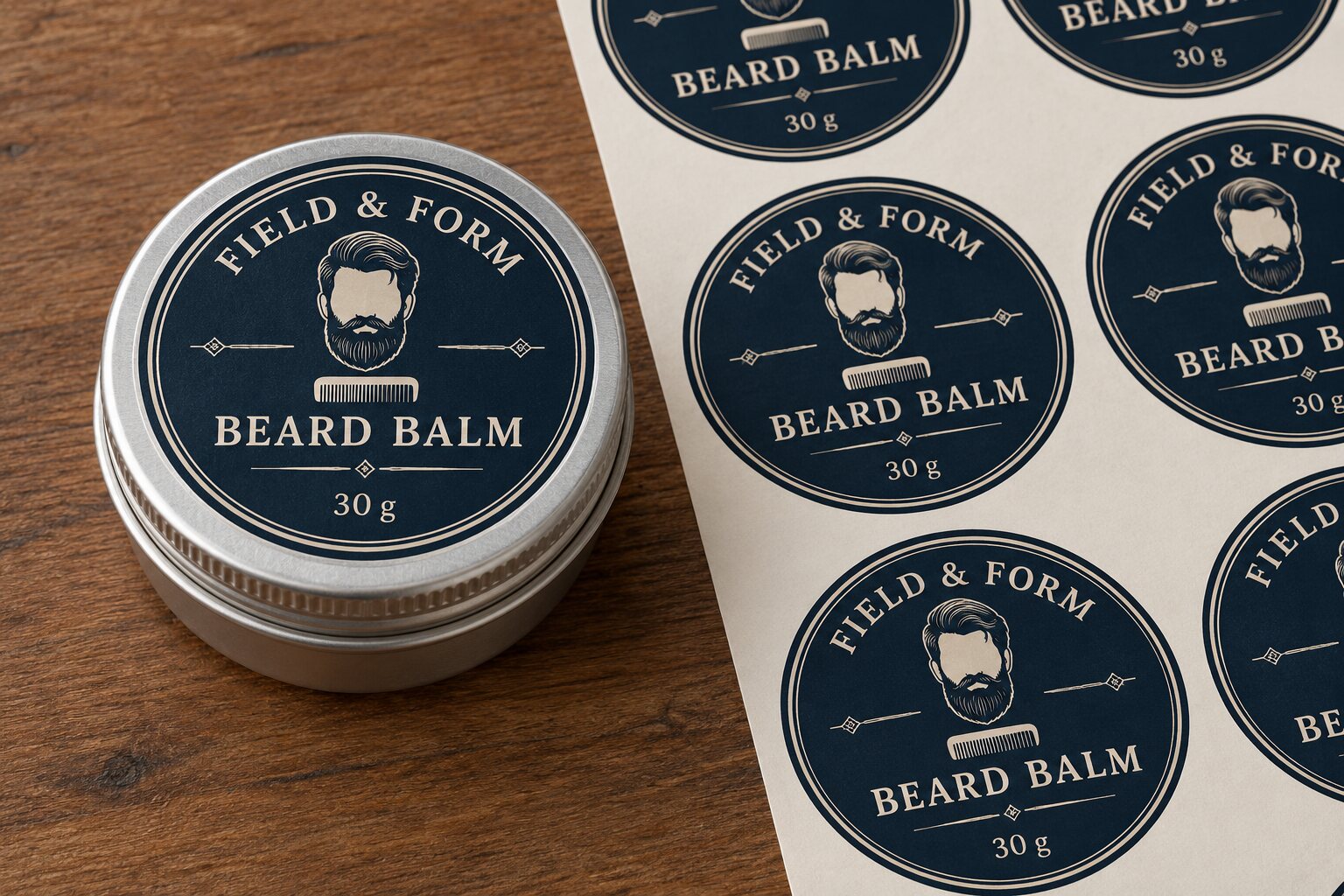
The example uses a beard illustration, comb icon, product name and 30 g line. Those are visual placeholders for an invented brand. A live artwork file needs the brand’s approved name, actual net quantity and required market copy. I would review the front at physical size: ornate borders cannot compensate for a product name that disappears at arm’s length.
If several scents or formulas share one tin, put the variant in a consistent place and proof every version. Compare the base design against a nearby cosmetic jar label; a lid circle carries a different hierarchy from a sidewall wrap.
Choose a material against the real lid finish
The image cannot tell us whether an adhesive will stay flat on a coated, brushed or oily metal surface. Supply the actual finished lid and describe filling, handling and storage. Avery Dennison’s adhesive glossary
I would inspect a printed and applied sample after the normal opening motion, especially where fingers grip the rim. A nice digital mockup does not reveal edge lift or a poor cut through the label liner.
Quote the lid and any secondary label separately
Send tin diameter, flat-top diameter, lid material and finish, approved artwork and quantity, number of variants, application method, and whether an underside or side information label is also needed. Ask for the cutline and a physical lid-top sample before bulk sign-off.
I would settle the usable circle first, then consider metallic ink or a textured stock. The label has to survive the lid’s real opening path, not just look centred in a product photograph.
Related label guides
Browse all packaging guides · Prepare a complete label specification
Plan your label project
Share the real package, dimensions, approved artwork and copy, quantity per design, intended handling and application method. We can review print and fit options and prepare a digital proof; physical performance and production terms need project-specific confirmation.
Request a Cosmetic Labels Quote