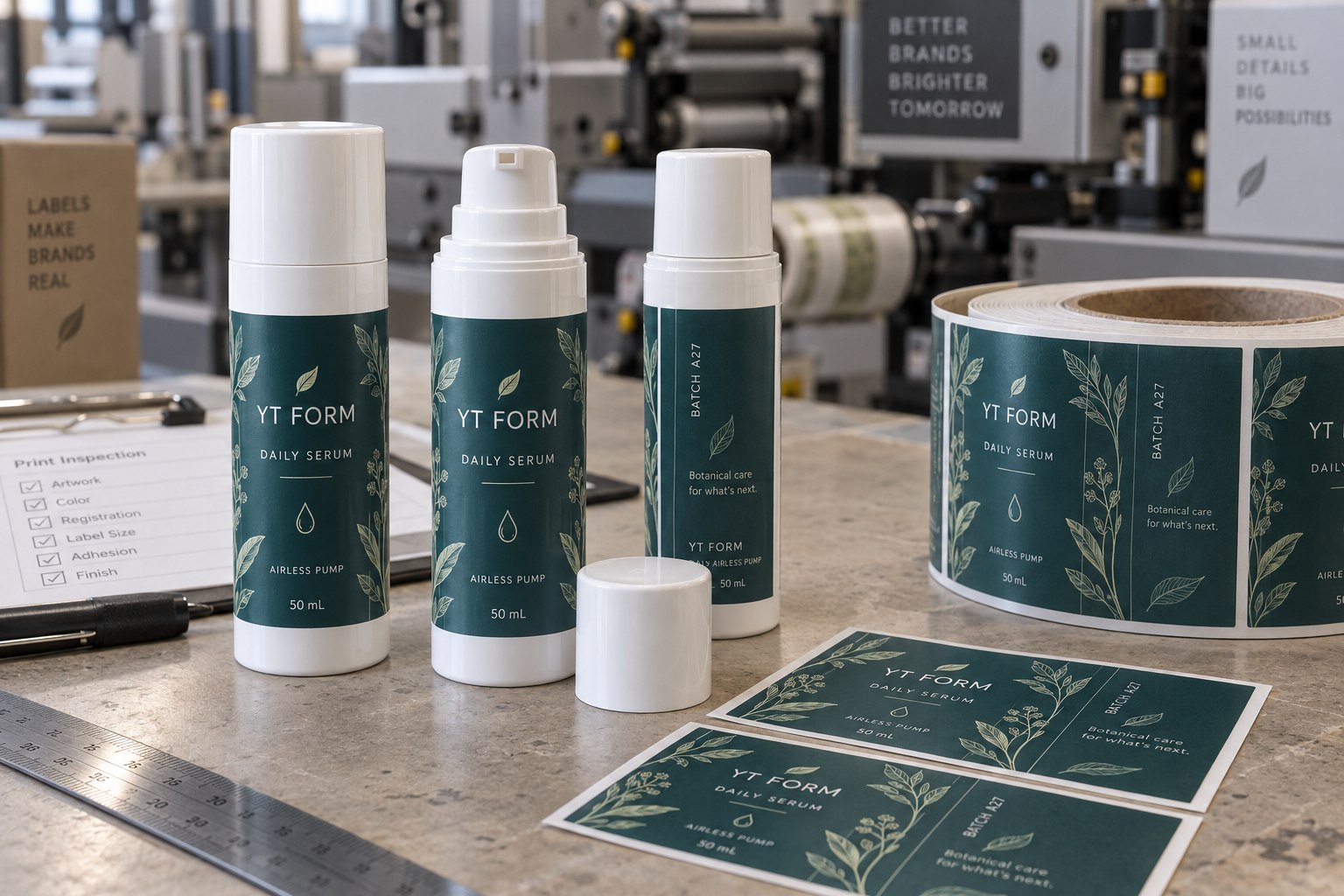
Start with the assembled bottle, not its advertised capacity
For airless pump bottle labels, the useful measurement is the available exterior panel on the exact assembled pack. A stated capacity such as 50 mL does not tell a designer the label width or height. Two bottles sold at the same capacity can have different collars, overcaps, base designs and wall diameters.
Ask the container supplier to identify the approved decoration area and any vent, joint or moving component that must remain clear. Measure with the cap on, then remove it and operate the pump according to the supplier's instructions. The label should not bridge a removable cap or hide a feature needed for normal operation.
Two buyers, two sensible decisions
Consider two illustrative buying situations, not customer case histories. A skincare founder wants a small trial range with three formulas. She puts the samples in a row and keeps changing the order, looking for a family resemblance. A printed label can give her room to revise the range without redesigning every bottle component.
A second buyer already has a stable high-volume range and strongly dislikes a visible label edge. Direct container decoration may deserve a quote alongside adhesive labels. As a label supplier, we have an interest in the label order; that does not make labels the right answer for every pack. The useful comparison includes design changes, production quantities, decoration limits and the approved physical result, not just the first unit price.
Separate wrap width from label height
On a genuinely straight circular panel, circumference provides a starting point. For example, an illustrative 35 mm diameter with a 2 mm seam gap gives a preliminary width of π × 35 − 2, approximately 108.0 mm. That is geometry, not a production recommendation. The gap must be chosen for the container and application process.
Height is a separate decision: measure the usable wall between the collar and base restrictions. A tapered body, recessed panel or raised seam needs a different fit assessment. Use our wrap label size calculator only for a straight cylindrical panel, then confirm a printer-approved dieline.
Let the graphics do a real job
The illustrated teal packaging uses botanical linework and small leaf and droplet graphics. Those are recognition devices, not claims that the formula is certified, organic or clinically tested. Keep the brand, product name and formula identifier in stable positions across the range; change one controlled colour or graphic element for each variant.
I would first check whether someone can distinguish the products at arm's length. Then I would check the side information at actual printed size. A generous logo is not an excuse to squeeze the information panel into whatever space remains. Leave the final required wording and any regulated symbols to the responsible brand team.
Review the whole label construction
Face material, adhesive, print and protective finish form one construction. Ask for options that match the bottle surface and anticipated handling. A clear film may preserve a bottle finish; an opaque label may give artwork a more consistent background. Neither appearance alone establishes adhesion or resistance to formula spills.
Avery Dennison's beauty and personal-care material overview shows that this category includes different material and finish technologies. It is background for discussing options, not proof that a particular construction will work on your bottle. Test the proposed sample on the actual pack.
A proof check worth putting on the desk
Keep one assembled bottle, the approved artwork and a labelled physical sample together. Check the top and bottom clearance, seam position, cap removal, product identification and the appearance after normal handling. Record the sample construction and the conditions used; a digital proof cannot establish these physical results.
For an illustrative order of three designs at 600 labels each, the total is 1,800 labels. Quote the three designs separately even when they share one size. Include bottle drawings, photos, quantities, application method and the requested destination. The custom label buying guide lists the remaining brief details. Approve the body fit before debating the last millimetre of logo size.
Related label guides
- Toner Bottle Labels: Material and Artwork Guide
- Frosted Glass Bottle Labels: Material and Design Guide
Browse all packaging guides · Prepare a complete label specification
Plan your label project
Share your packaging dimensions, artwork versions, quantity per design and intended use. We can review label options and prepare a digital proof; physical performance and production terms need project-specific confirmation.
Request an Airless Bottle Label Quote