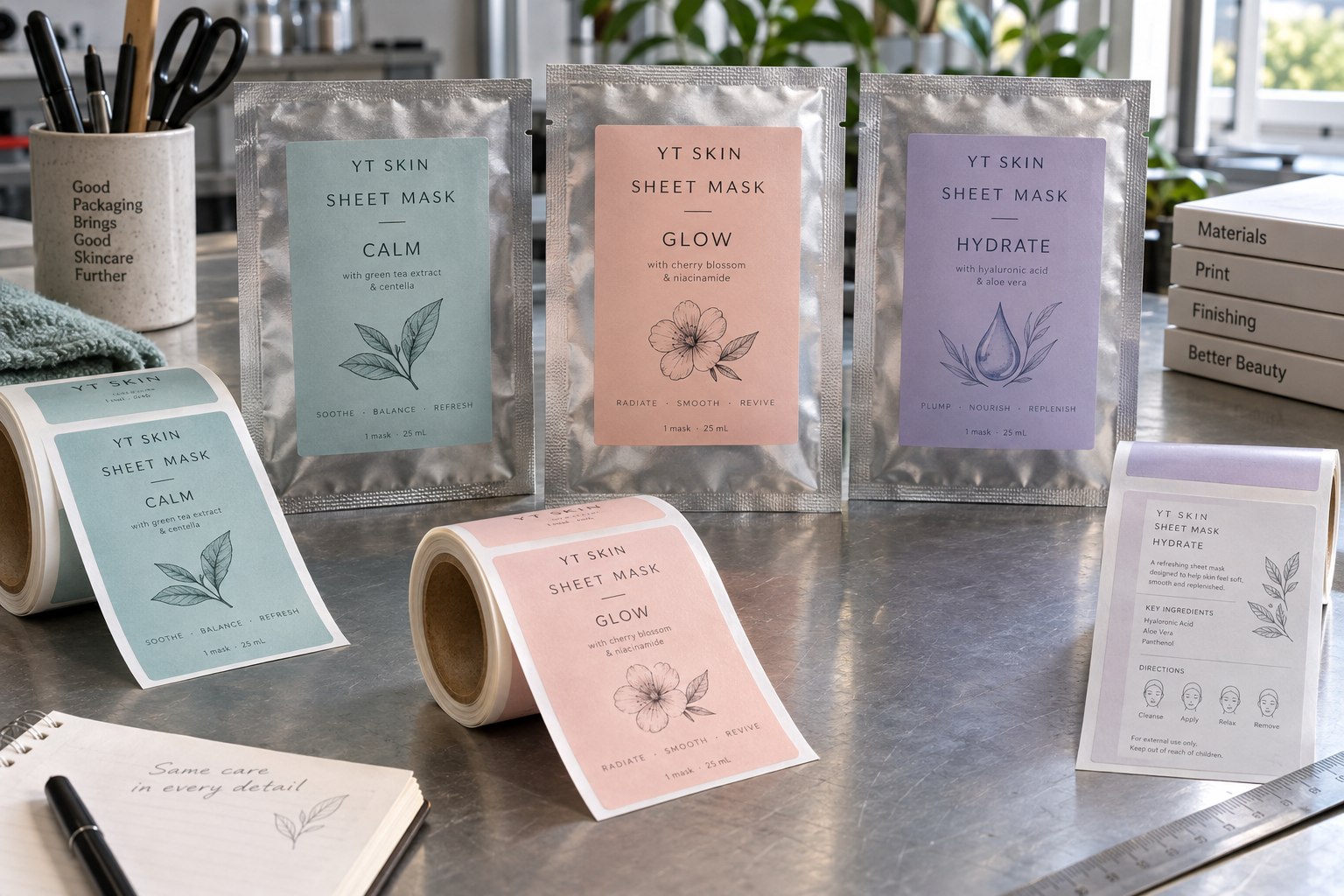
Printed pouch or applied label?
A directly printed pouch can give a continuous finish without an adhesive edge or a separate application step. For a stable range and a suitable production quantity, that can be a sensible option to quote. A separate printed label may help a small range use one base pouch while varying front artwork, but it adds label application, alignment and a second material to approve.
Neither route wins on appearance alone. Compare complete unit costs, artwork revision costs, lead times, and who applies the labels. A fast quotation for labels can look attractive until the filling partner says it has no labelling station.
Material maker Avery Dennison describes flexible plastic packaging across personal care and cosmetics and notes that application conditions change performance needs. That supports treating a sachet as its own label application rather than assuming a bottle label will behave the same way.
Find a genuinely flat panel
Lay an empty sachet and a filled sachet side by side. Mark the seal, tear notch, crimped corners and any panel that bulges after filling. A label placed across a heat seal or tear feature can impair opening or look distorted. The print file should use the usable flat area, not the pouch's total outside dimensions.
If the pouch will be handled wet, ask the converter to propose a full construction: face material, adhesive, print and finish. A digital proof can confirm layout and text, but a physical sample on the filled pouch is needed for edge appearance, adhesion and handling checks. Agree what “pass” means before trying a water or rub test.
Give each variant a recognisable front
A complete label should identify the product, not merely decorate the foil. Keep the brand, “Sheet Mask” and the variant name in stable positions. Use an original botanical or ingredient-inspired illustration as a visual cue, without making an unsupported ingredient or performance claim. Icons can improve shelf recognition; they cannot substitute for approved product information.
For a hypothetical three-variant launch of 400 pouches each, the brief is three designs at 400 labels, plus a decision on whether the back carries a separate label. “1,200 labels” alone hides the artwork count. Ask the responsible brand team to supply the final ingredient, use and market text rather than letting the designer invent it.
Check the packing motion before placing the order
Watch a few labels being peeled and applied to the real pouch. If a hand-applied label repeatedly lands crooked because the sachet folds under pressure, revise the label size or process. If the range grows and the artwork settles, quote direct pouch printing again. We supply labels, but the buyer should be allowed to choose a route that removes an unnecessary step.
Send the pouch material, flat-panel dimensions, filled samples, designs, quantities and application method with your YT Labels inquiry. The custom label buying guide covers the rest of a usable brief.
Related label guides
Browse all packaging guides · Prepare a complete label specification
Plan your label project
Share your packaging dimensions, artwork versions, quantity per design and intended use. We can review label options and prepare a digital proof; physical performance and production terms need project-specific confirmation.
Request a Cosmetic Labels Quote