Measure the tube as two moving components
Ask the component supplier for the assembled tube and its drawing. Mark the cap, the fixed body, the join and any mould seam. Measure the straight section that can accept an applied label, then leave tolerance at both ends. Do not infer a usable label height from the total tube height.
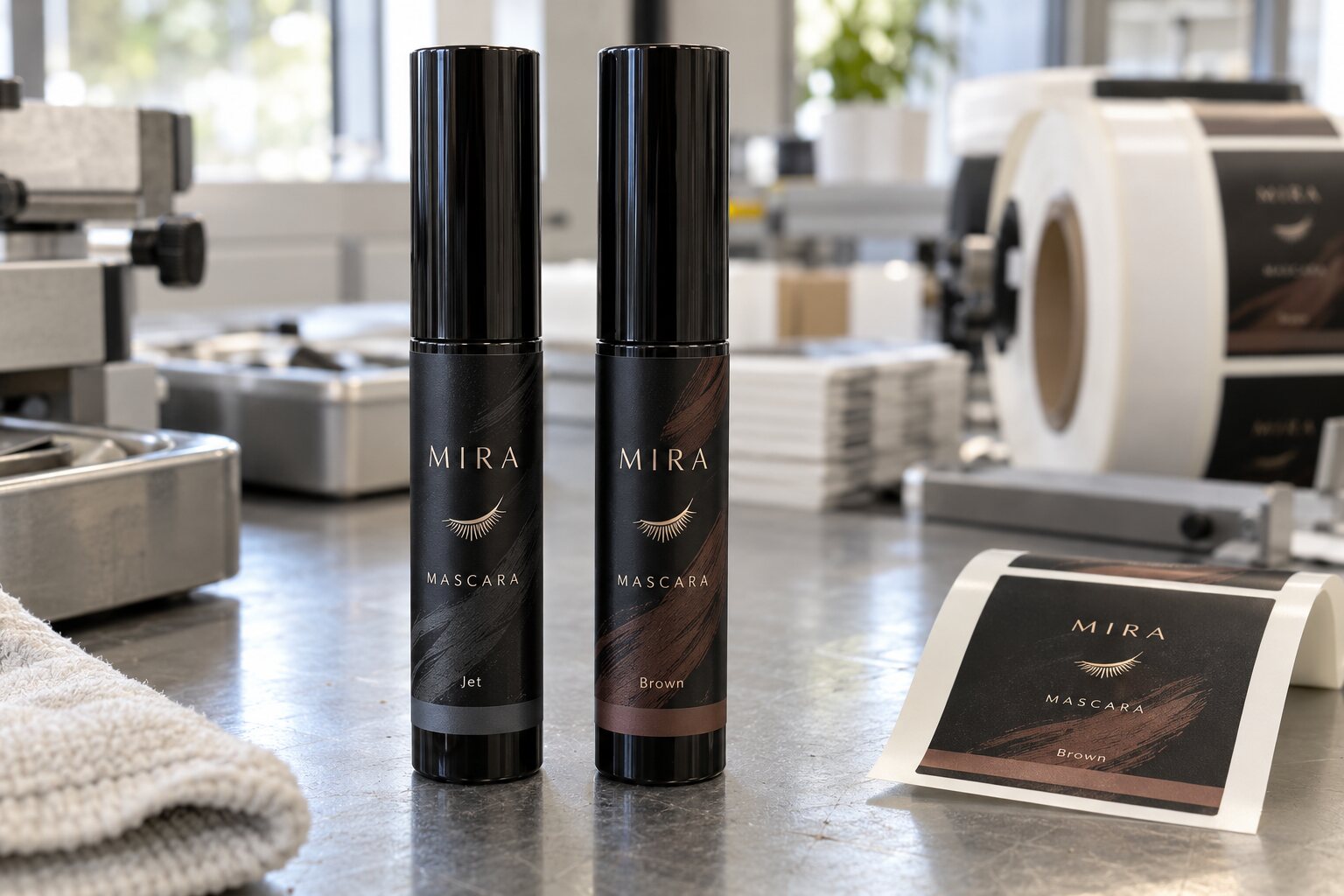
The illustrated MIRA Jet and Brown range keeps the label entirely on the fixed body. If the body is too short for approved copy, price a smaller front label plus an outer carton or a peel-back construction. A slim tube cannot be made larger by reducing every word to six-point type. A different component may be the more honest option.
Make the shade readable before adding decoration
With the two tubes side by side, the brand and product name should stay in the same place while the shade name changes clearly. The small eyelash motif is a visual cue, not a performance promise. A decorative icon cannot replace the approved product identity, net quantity or other market-specific information.
The brand team should supply final copy and check the destination market. The FDA cosmetics labeling guide explains US requirements and why claims and intended use matter; it is not a substitute for reviewing the actual formula and sales territory. Do not print a made-up approval seal to make the tiny pack look official.
Proof on the component, not just on a PDF
Ask for a print proof at actual size and a physical label on a filled or production-equivalent tube. Twist the wand cap repeatedly, inspect edge lift near the seam, and look at alignment from more than one angle. Tell the converter whether a person applies the label or an applicator does. That changes roll format, gap and orientation requirements.
Material selection is a complete construction question: face stock, adhesive, ink and protective finish. Avery Dennison's home and personal-care material overview shows options across containers and formats; it does not certify any particular construction for your mascara formula or handling. Request a sample under your own conditions.
Quote the artwork count honestly
Suppose a planned launch has two shades at 500 units each. Tell the printer two artworks at 500, not one artwork at 1,000. Send the tube, measurements, cap drawing, approved copy, artwork files, label application method and expected quantity per shade. Compare applied labels with direct decoration if your component supplier offers it. The right solution is the one your packing team can repeat, not the one that only looks good at 200% zoom.
Our cosmetic label collection and label buying guide can help you turn those details into a useful quote request.
Related label guides
Browse all packaging guides · Prepare a complete label specification
Plan your label project
Share your packaging dimensions, artwork versions, quantity per design and intended use. We can review label options and prepare a digital proof; physical performance and production terms need project-specific confirmation.
Request a Cosmetic Labels Quote