Measure the part that stays still
The tube body and the wand cap move separately. Measure the straight printable wall on the exact filled component, then mark the shoulder, base radius and any mould seam. Keep the main label on the body, away from the opening joint. A digital drawing that treats the entire tube as one cylinder can make a cap-crossing label look feasible when it is not.
Ask for a physical sample of the proposed label width. On a narrow transparent tube, a broad opaque label may hide the very gloss colour the buyer wants to show. A smaller front label and a second information label can be worth pricing alongside a full wrap. Neither is automatically cheaper once the extra artwork and application steps are counted.
Build a shade system, not three unrelated mini posters
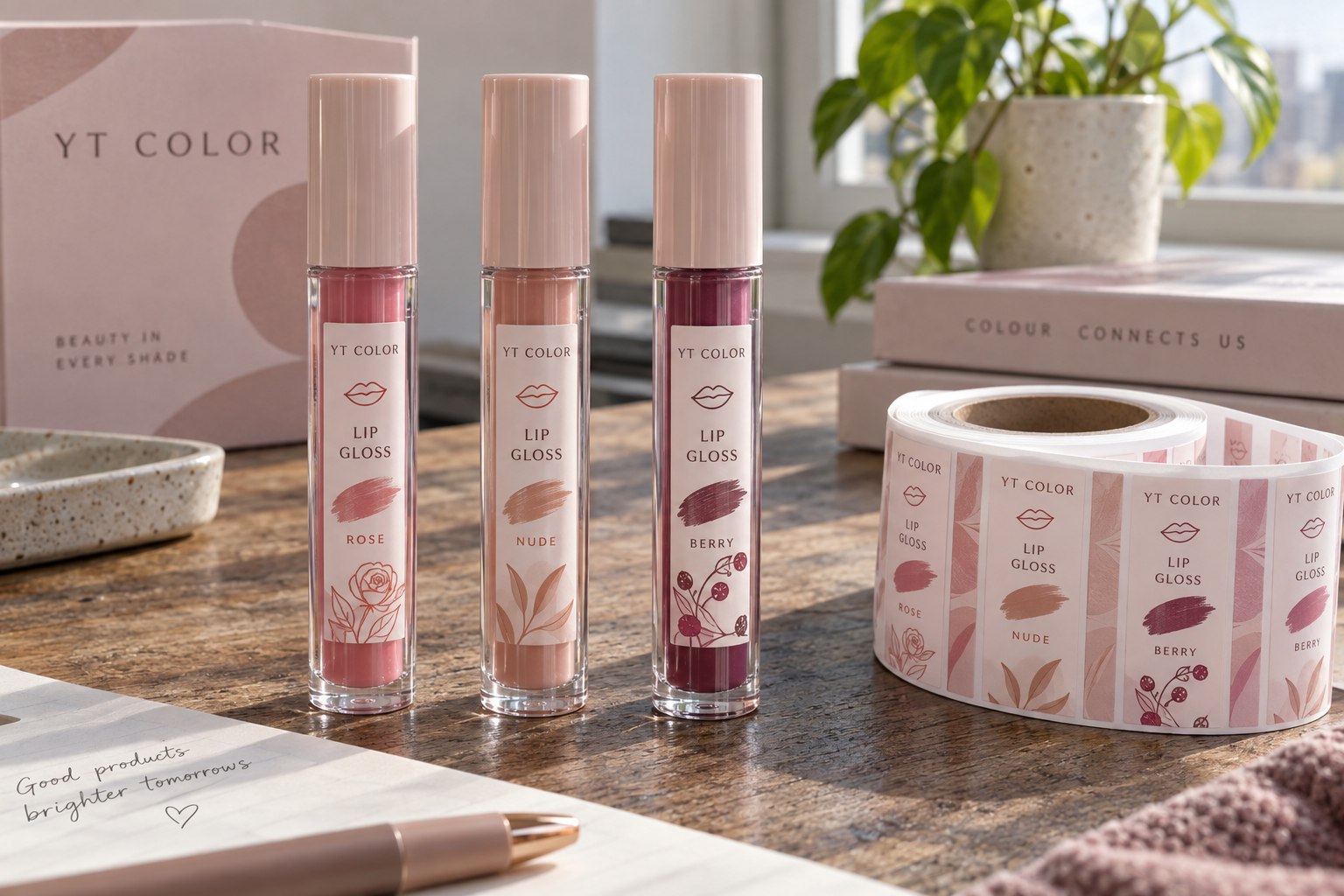
The illustrated Rose, Nude and Berry labels keep the fictional brand and “Lip Gloss” in stable positions. A small lip line icon and controlled colour swatch make each shade recognisable without turning the pack into three different brands. The icon is decorative, not a product-performance claim. For a larger collection, a short shade code can help the packing team distinguish similar colours; the brand team must approve the actual names and codes.
I would test the front at arm's length, then turn the pack and check the smallest approved information at actual print size. A beautiful mockup enlarged on a laptop is a poor judge of a tube label only a few centimetres tall. Do not invent ingredients, claims or market-specific text to fill white space.
Choose the construction for the real contact conditions
Gloss can reach fingers, cap threads and the outer tube during use. That makes smudging, edge lift and readability worth checking on a filled sample. Face material, adhesive, ink and protective finish should be reviewed as a combination, not as a single promise that a label is “waterproof.” Avery Dennison's beauty and personal-care overview shows that multiple material and finish technologies exist; it does not prove a particular one will survive your formula.
Let the converter know whether labels are hand-applied or run on an applicator. Confirm roll direction, core and gap only after the pack and equipment are known. If the tube supplier offers reliable direct decoration, quote that route too. An applied label is valuable for changing shades, but it should not win by default.
A quote brief that exposes the expensive details
Send an assembled tube, cap drawing, straight-wall measurements, photos, approved front and back copy, shade count, quantity per shade and application method. Ask for a print proof and a labelled physical sample. If three shades need 600 labels each, state three artworks at 600—not merely “1,800 labels.”
Compare the actual applied result next to the filled colours. Check cap clearance, alignment, the visibility of each shade and normal handling. Our custom label buying guide helps complete the brief; the cosmetic label range shows other container formats. A tiny label earns its space when a buyer can choose the right shade without squinting.
Related label guides
Browse all packaging guides · Prepare a complete label specification
Plan your label project
Share your packaging dimensions, artwork versions, quantity per design and intended use. We can review label options and prepare a digital proof; physical performance and production terms need project-specific confirmation.
Request a Cosmetic Labels Quote