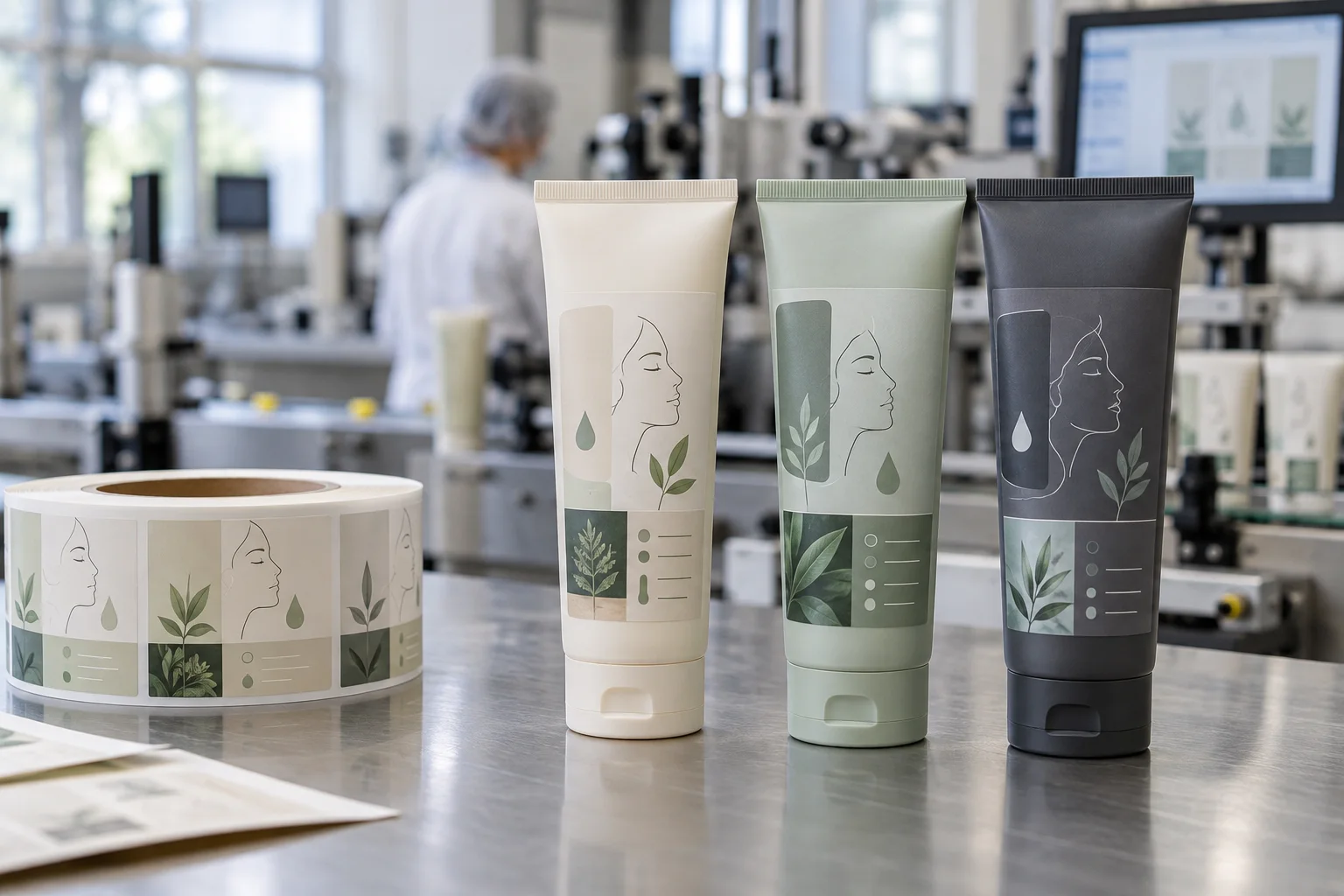
Find the tube's stable front panel
Measure the straight section after the tube is filled, including the shoulder transition, cap clearance and back seam. A label that reaches too far into a squeeze zone can crease even when its die line is technically correct.
Let the icon system carry the range
A droplet, face profile, botanical sprig or texture mark gives a cleanser range an immediate visual cue without copying a known brand. Keep the product type prominent, then use color and one controlled icon family to separate gel, cream and exfoliating formats.
Do not confuse minimal with unfinished
The front can stay quiet while still looking complete: product hierarchy, a purposeful graphic mark, a colour field and a restrained information zone are enough. Empty white space becomes useful only when it supports a clear decision for the shopper.
Choose label construction around flex and moisture
Facial cleanser tubes are squeezed, carried into wet bathrooms and often stored cap-down. Film label materials are commonly considered where moisture resistance and flex matter; the final construction should follow the tube resin, surface, product exposure and application method.
Make the roll work for the applicator
Confirm label orientation, gap and unwind direction before production if the tubes will be applied on a line. A print-ready file is not automatically application-ready. This is one of those small decisions nobody notices until the line pauses for it.
Proof on the real tube at real size
Send a tube sample or accurate dimensions with your artwork, finish preference and quantity. Check the front view, seam position and cap relationship together. For another flexible cosmetic format, see our sunscreen tube label guide.
Need facial cleanser tube labels?
Share your tube dimensions, artwork and quantity for practical material options and a free digital proof.
Request a Cleanser Tube Label Quote