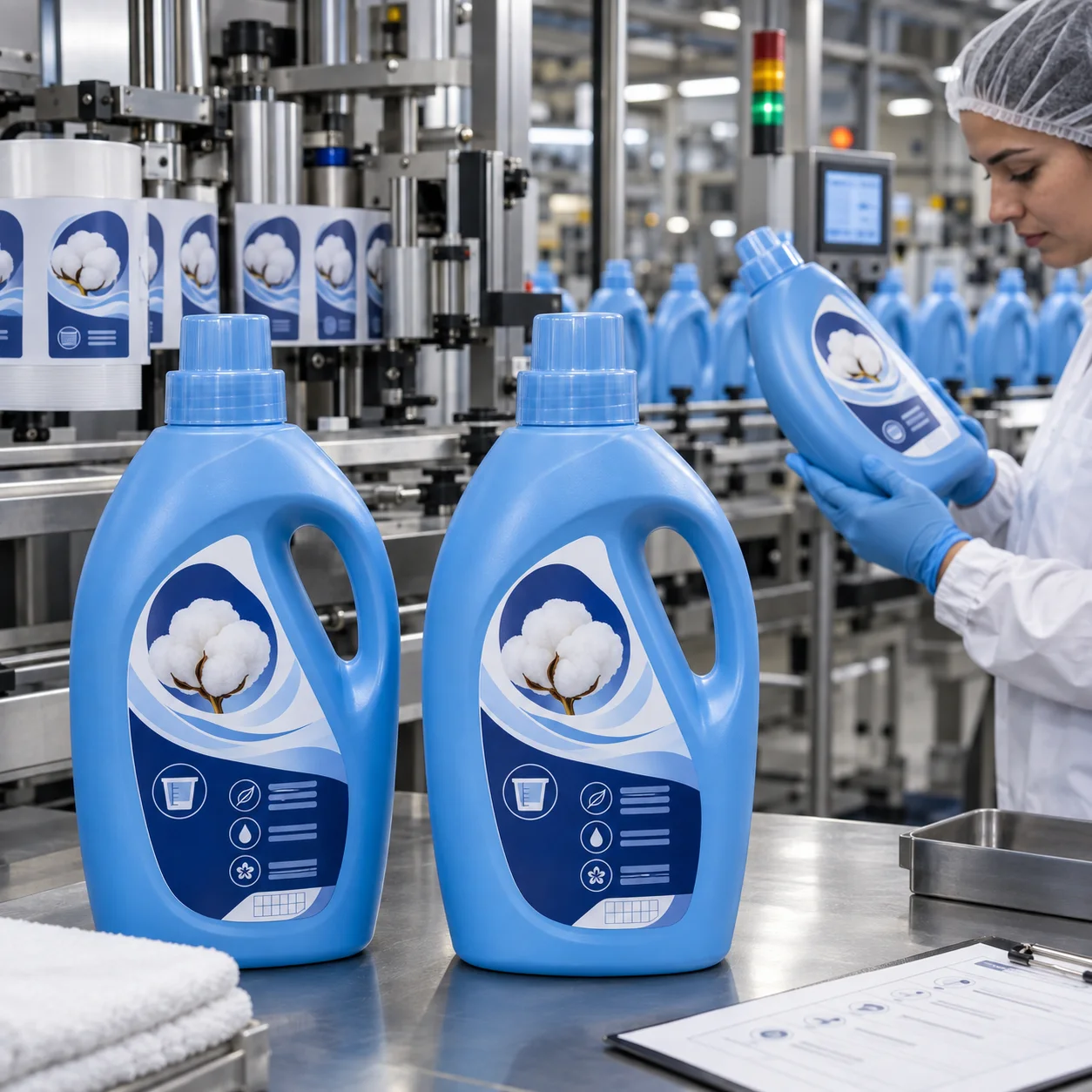
Map the bottle's working surfaces first
Large HDPE softener bottles can have recessed panels, a molded handle, tapering walls and shoulders that move as the bottle is filled. Photograph the front, back and side of the real pack. Measure the flatter application zone rather than drawing a rectangle over the widest point.
Some brands choose a large front label and a practical back label. Others want wraparound decoration. A wide wrap can look strong, but it needs room for handle clearance, contour changes and an application tolerance. It is a production choice, not just a design choice.
Choose durable label construction
Laundry-care bottles may be handled with wet hands, stored in humid rooms and transported in cases where surfaces rub together. Film materials and suitable adhesive options are commonly considered for these conditions. The best construction depends on the bottle resin, surface texture, fill product, storage and application method, so those details belong in the quote request.
Do not let the front label become a claims wall
Product type, fragrance or variant and the brand need to be visible quickly. Use the back label for directions and other supporting information, then have the responsible team validate market-specific wording and symbols. A front panel stuffed with every message makes a large bottle feel less clear, not more premium.
Think about the shelf test: if two blue bottles sit together, what lets a buyer identify the variant without rotating both? That answer should direct the layout.
Give the handle and cap space to move
Keep critical copy away from a handle opening, seam, deep recess or high-flex curve. A panel that looks symmetrical on a die line can be visually off-center after the bottle is filled and squeezed. Review a physical sample when the shape is unusual or the label reaches close to the edges.
Specify rolls around the real packing workflow
Hand-applied labels, semi-automatic equipment and fully automatic lines need different practical allowances. Provide your bottle orientation, label position, applicator type and desired unwind direction. Getting this right before print is quieter than correcting a perfectly printed roll that cannot run efficiently.
Build a proof around the actual SKU range
Share bottle images or samples, label panel dimensions, artwork, material preference, quantity and number of variants. Review the proof at size and confirm color differences across the collection. For detergent-specific planning, see our laundry detergent roll label checklist.
Need fabric softener bottle labels?
Send your bottle dimensions, artwork, quantity and application method for material guidance and a free digital proof.
Request a Fabric Softener Label Quote