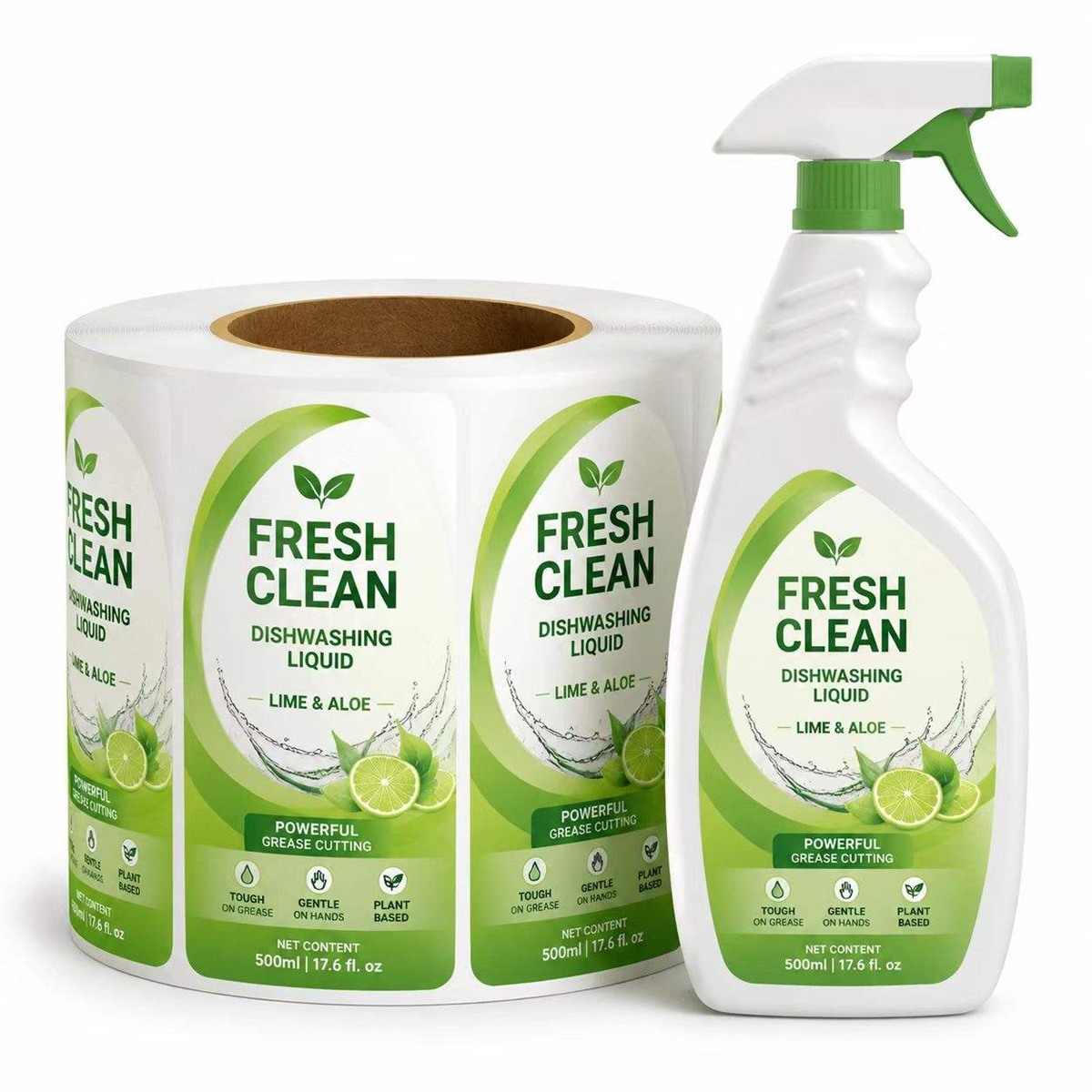
Why dish soap label planning starts with the package
A label that works on a rigid front-panel bottle may not work on a flexible pouch or a curved refill bottle. Before selecting material or finish, identify how the package is held, squeezed, stored and filled. Product contact, condensation, splashes, repeated handling and curved edges all affect the label approach. A photo of the actual container is one of the fastest ways to avoid choosing a label shape that looks good flat but performs poorly after application.
Choose a format for each package type
Front and back labels, or a wraparound format, can give the product name and usage information clear dedicated areas.
Plan the front label around the usable flat panel and keep key information away from sharp curves and application seams.
Allow for flexible movement, pouch seams and changing panel shape when the pouch is filled or partly empty.
Keep the brand system recognisable, but use dimensions and safe areas that suit the refill package rather than copying the bottle label exactly.
Water resistance is more than the face material
For dishwashing liquid and hand-dish soap, buyers often choose synthetic film labels and protective finishes because the package may be handled around water. Material, adhesive, printed surface protection and bottle surface should be considered together. The best option depends on the actual bottle or pouch, storage conditions and how labels are applied, so a production check is better than assuming one material suits every project.
Keep the front label clear in a crowded category
Dish soap packaging often needs a brand, product type, fragrance or variant, volume and other market-specific information. Start with the content shoppers need to recognise first. Use a consistent brand and product hierarchy across variants, then let color or small graphics differentiate lemon, aloe, antibacterial, concentrated or refill options. Avoid pushing tiny text too close to a curved edge, shoulder or pouch seam.
Plan variants and refills as one wash care system
When a brand offers a bottle plus a refill pouch, the two packs should be easy to identify as a pair. Keep shared elements such as logo, product family name and variant color. Then adapt the layout to the available panel. Viewing the complete group during proofing catches mismatched colors, unbalanced front labels and labels that become hard to distinguish in a retail or kitchen setting.
Artwork and quote checklist
- Photos and material details for every bottle, pouch or refill pack
- Label width, height and the available flat application area
- Quantity for each pack size and fragrance or variant
- Artwork with market-specific required information checked by your responsible team
- Preferred finish and a reference for the intended brand style
- Roll direction or sheet requirement for the application process
See more formats in our wash care labels catalog. For laundry product packaging, read the laundry detergent label checklist; for material planning across personal and wash care products, see waterproof label material options.
Buyer FAQ
What labels work for dish soap bottles?
Waterproof synthetic film labels with a suitable adhesive and protective finish are common options for dish soap bottles. The final choice should be checked against the bottle surface, moisture exposure, label size and application method.
Can the same dish soap artwork work on a bottle and refill pouch?
The brand system can stay consistent, but the label dimensions, panel shape and safe area should be adjusted for each package. A proof should show both formats at their final size before production.
Need labels for a dish soap bottle or refill pack?
Send container photos, sizes, quantities and artwork. We can help check practical label formats before quoting.
Send Dish Soap Label Details