
Obtain a reference the reviewer can actually use
Request the brand-approved source text in its intended form, with product and revision clearly identified. Name the person qualified to review the language and the person responsible for editing the layout. Do this before the only available reference becomes a screenshot forwarded through several messages.
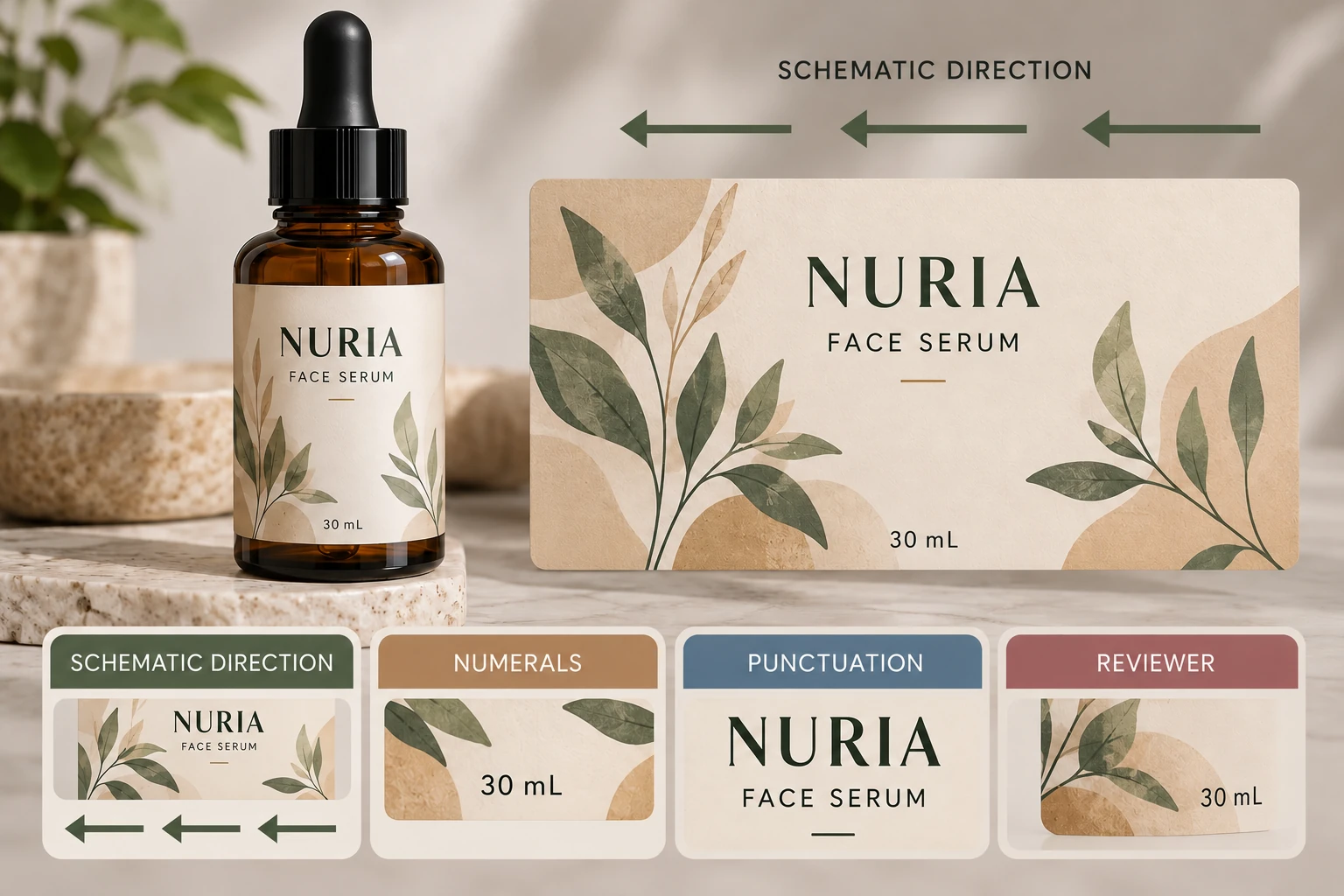
Ask the content owner to identify mixed elements that need attention: brand names, numerals, units, punctuation, parentheses, addresses or another approved component. The exact issues depend on the script and content. Do not apply a universal visual reversal rule to every line.
The buyer's role is to ensure these elements are reviewed, not to improvise a translation. If the approved source itself is disputed, resolve that with the content owner before asking prepress to make the characters look closer to a reference image.
Confirm that the authoring workflow supports the script
Adobe's Illustrator guidance on Asian composers describes support for complex-script composition and distinguishes language capabilities across versions. It provides a reason to check the actual installed workflow, rather than assume every edition exposes the same controls.
Ask the designer to confirm the supported composition and font arrangement for the supplied script. This article does not prescribe a menu sequence for every software version. The correct configuration belongs with the person operating that authoring system.
Avoid manually moving characters into a visually convincing sequence without understanding the text. Such a local adjustment can conceal an unresolved source or composition issue. Have the designer and language reviewer agree how the editable master and final export will remain consistent.
Review the export, not just the editable master
The printer receives a particular output file. Identify that PDF or other accepted export by revision and review its rendered content. Check actual-size legibility as well as enlarged details where necessary. Zooming can help inspect a mark; it does not demonstrate that the final label is readable at its supplied size.
Our PDF font checklist covers font status and visible characters. Add the language-specific reading-order review to that record. Correct font reporting does not prove that a mixed number-and-text phrase reads as the content owner intended.
If the printer's output route changes the artwork preparation, identify which proof represents that route. The export guide explains why technical preparation should be agreed. Ask for another language check of affected content when the actual output changes.
Use a location-based language proof sheet
Make comments specific enough for the designer to reproduce and for the reviewer to close.
| Field | Record | Why it matters |
|---|---|---|
| Source | Approved copy file and revision | Establishes intended content |
| Output | Exact PDF and panel | Identifies what was inspected |
| Location | Block, line or marked area | Makes the observation actionable |
| Element | Joining, direction, numeral, unit or punctuation | Defines the concern without guessing its cause |
| Comparison | Reviewer description against approved source | Separates intended content from appearance alone |
| Correction | Changed source/layout and replacement output | Preserves the route to the corrected file |
| Closure | Competent reviewer and accepted revision | Connects approval to production |
Begin with source and output identity. Have the language reviewer read the complete relevant passage, then inspect mixed elements in context. Record discrepancies, obtain the designer's correction and review the replacement export. Check surrounding content as well as the isolated change, since a local edit may affect the line arrangement.
Leave the affected language release pending if nobody competent has reviewed it, if the source is uncertain or if the printer will use a different unreviewed file. A client saying the decorative panel looks good does not fill those gaps.
Scale the review to the actual change
A hypothetical repeat job may use the same identified output and an existing documented language approval, with no relevant preparation change. The team can confirm those facts rather than manufacture a new translation problem.
A new language version, a new font or a revised mixed numeral-and-text line needs a more focused check. Outlining the artwork may be an agreed output choice, but it is not a language approval and should not replace preservation of the editable source. Ask prepress which route it accepts and retain the reviewed result.
For custom cosmetic labels, supply the container, label dimensions, quantity per version, approved source and current export. Identify the exact passage and responsible language reviewer. The inquiry form prepares a message; send files through email or WhatsApp. Close the reading-order question on the file that will actually be printed.